

Have you ever tried to toss (or "launch") your pizza in your pizza oven and failed? Like , did your dough stick to the peel while your precious toppings floated to the bottom of the oven ? The result: you spent more time cleaning the pizza stone than baking pizzas that night. It's inevitable! You're not alone, and we've all been there.
Stephany writes to us: "We tried preparing our pizza on a sheet of metal, on the counter...and it seems like it's never slippery enough not to destroy the creation 😅"
For us amateur pizza makers , mastering the art of throwing pizza dough into the oven without it sticking is a true rite of passage! Practice makes perfect , as they say.
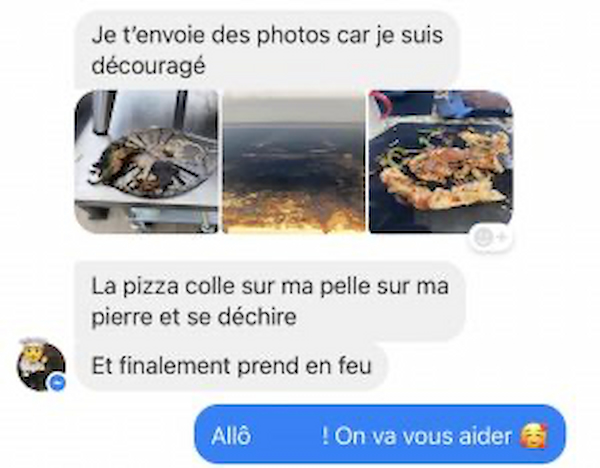
With a little effort, and especially with our foolproof tips, you'll be eager to toss your pizzas every single time, we promise! ✌🏻 Okay, given the mess of toppings you made at your last pizza/beer night, it might sound crazy… but we firmly believe you can do it. Forget those old wives' tales about parchment paper (we love you, Yvette).
We're sharing our 5 solutions to prevent your pizza from sticking to everything else.
1. Plan to cook your pizza dough at the right temperature 🌡
First things first, if it's sticky, it's a sign that your dough is probably too cold or too hot. If you cook with pizza dough that's too cold , it will be difficult to work with. It will tend to tear, stick, and curl up on itself. Not ideal for effective removal. Conversely, if your clay is too hot , it will release moisture, which will literally act like crazy glue between your clay and your peel. You'll also notice that hot clay stretches to the point of being too thin and tears like silk. Get out your thermometer ! The ideal temperature, the sweet spot , is between 60°F and 70°F (15°C and 21°C), which is room temperature.
👉🏻 What do we say to that? That you need to be *a little* proactive by taking the pizza dough out of the refrigerator in advance (and the sauce too). We recommend taking your pizza dough out about 4 hours beforehand and storing it in a room with a moderate temperature ( like, avoid leaving it on the counter in the blazing July sun). Besides making it easier to roll out, the dough will be easier to stretch. Goodbye humidity and holes. Two birds with one stone!
2. Flour everything
How to put it? Flour everything like there's no tomorrow, use it liberally, it's not ointment! Flour your hands, the pizza dough, the work surface, and especially the pizza peels. You read that right! We'll explain why you need more than one 👇🏻 Worried about using too much flour? You can use a perforated pizza peel ; the holes release the excess flour, preventing the crust from burning.
👉🏻 Us? We like to use durum wheat semolina for our Neapolitan pizzas . Some swear by cornmeal ( hello texture!). We use that one more often when making New York-style pizza.
3. You will need not one, but two pizza peels!
The dough tends to soften and stick to the peel when it comes into contact with heat. It's best to work with two peels to keep the dough at a consistent temperature. The first peel is used to shape your pizza and place it in your pizza oven. The second is used to rotate and remove the piping hot pizza from the oven . In fact , the "preparation" peel never gets hot since it never comes into direct contact with the inside of the oven.
👉🏻 Personally, we often use a wooden peel to prepare and toss pizzas. To turn and retrieve the pizza, we use a perforated rectangular peel. Another option is to use a peel designed for turning the pizza while cooking, paired with a second wooden peel to place the hot pizza on.
For our experienced cooks, we can move on to counter preparation and sliding on the peel. But that's a whole other level! We'll talk about it later!
4. Be quick (and especially organized) to build your pizza crust
You're organized and efficient! We can see you wanting to build your pizzas in advance to avoid chaos. You stretch out all the dough balls, and the whole family gets involved. One by one, everyone builds their pizza to their liking around the kitchen island. Then, the pizzas wait in a line for their turn to get golden brown in the oven. But then… it starts sticking to the counter or the peel. Yes, yes, that's normal. Dough that's been stretched for a long time can become sticky, even gummy, which can make it difficult to remove. And this is especially true if there's a Leaning Tower of Pisa of toppings.
👉🏻 Quick tip: Build your pizzas as you go, then toss them in the oven as soon as your toppings are on top. Count to 1 to 2 minutes between the time the stretched dough touches the floured peel and it goes into the pizza oven. Having your pizza oven at the right temperature and your toppings ready in advance will allow you to complete this step with, well, so much ease.
5. Gently but vigorously shake your pizza peel before topping the crust
When your pizza is stretched on your peel, and you think you're ready to add the sauce and toppings, STOP! At this point, always, always, always, always take the time to do the shake 'n bake test. Take your peel and shake it. If the dough moves, you're good to go for the toppings! If the dough sticks to the peel and won't budge, no worries . Lift one edge of the dough and add a little flour to the peel.
And… watch out for the toppings! When you're spreading your sauce, you literally have to use the back of a spoon – you don't want it dripping onto the peel – it can affect how the dough throws in the pizza oven. Same goes for the thickness of your toppings. Funny story: we once saw Max's pizza ingredients take a spectacular flight to the bottom of the pizza oven 🤦♂️. Max is Christiana's brother and a fan of ultra-funky pizza (it runs in the family, I guess 🤷🏼♀️). That day, there was no way to salvage the damage (his face 🥵). Without hesitation, metal Gi peel in hand , the pizza (what was left of it) was scraped off and tossed over the edge. We live on the edge of a cliff… You know what I mean?
👉🏻 Quick lesson of the day: pizzas with light toppings are easier to toss in and take out of the pizza oven because they don't put a ton of weight on the crust. Plus, they cook much more evenly ( burnt pizza with a raw crust in the center, anyone? ).
That's it folks! Those were our 5 simple tips to prevent your pizza from sticking to the whole world.
We sincerely hope ❤️ that these tips will help you avoid a disaster, so you can focus your energy on this moment of sharing! We say that, but the spectacular messes are always the most memorable! Like the pizza disaster in the Cape. There isn't a Friday pizza night that goes by without it being talked about.